Stamp Desk / Scripts of the world
Ottoman Empire, 1865 (1 kuruş)
A crescent and star in a lilac frame, under a heavy black boxed postmark.
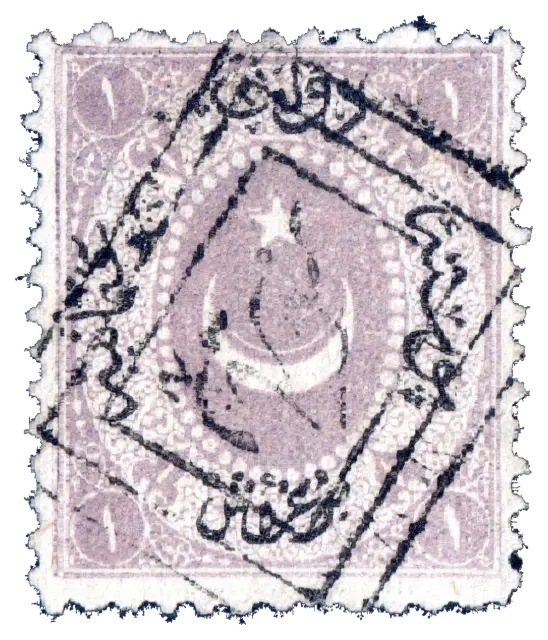
Illustration of a historical stamp for learning, shown at screen size. Not valid for postage.
How to read it
A crescent and star with Arabic-script lettering: the Ottoman Empire.
- 1Ottoman state post
- 2Crescent and star
- Inscription
- دولت عثمانیه · ١
- Meaning
- The black lettering names the post of the Ottoman state (عثمانیه, Ottoman); ١ is the Arabic numeral one. The kuruş (piastre) was the Ottoman coin.
- Issued by
- Ottoman Empire
- Today
- Turkey and its neighbours
- Year
- 1865. Issued 1865.
- Made by
- Mehmed Şevket Vahdetî (designer and calligrapher, died 1871); Pierre Edelestand Stanislas Dulos (engraver, died 1874); Sultan Abdülaziz (preliminary sketch designer, died 1876)
One fact
The 1865 stamps are called “Duloz” after their French engraver Pierre Dulos; the calligraphy is by Mehmed Şevket Vahdetî.
Source and public-domain rule
Creators died more than 70 years ago. Every named creator died more than 70 years ago: Mehmed Şevket Vahdetî (died 1871), Pierre Edelestand Stanislas Dulos (died 1874), Sultan Abdülaziz (died 1876). Copyright lasts for the life of the author plus 70 years, counted from 1 January of the year after death. Every named designer and engraver of the stamp died before 1 January 1956; any contributor who was never named counts as anonymous, whose term is 70 years from publication, and the stamp was published before 1956. Legal sources: Directive 2006/116/EC, Art. 1(1) life + 70 years; Art. 1(3) anonymous works 70 years from publication; Art. 7(1) comparison of terms for works from outside the EU; Art. 8 terms run from 1 January, Switzerland, Norway.
Scan: Turkey 1865 Sc10a.jpg on Wikimedia Commons (revision 1164826942), licence templates {{PD-old-100}}. Downloaded 2026-10-22, sha256 cbdd61ea10c2…; cropped and cleaned for this site. Facts checked 2026-10-22 against source 1 and source 2. Open review note: Heavy boxed postmark across the stamp.. Research record, not legal advice; a second check of these rights by a person is planned, and a stamp that turns out not to be free to use will be removed. Spotted a mistake? Tell us.
