Stamp Desk / Scripts of the world
Greece, 1896 (40 lepta, amphora)
An ancient two-handled vase under an arch.
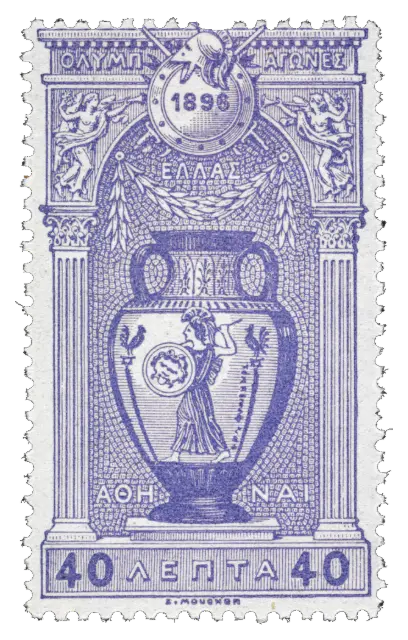
Illustration of a historical stamp for learning, shown at screen size. Not valid for postage.
How to read it
ΕΛΛΑΣ, Greek for Greece, under the words for Olympic Games.
- 1ΟΛΥΜΠ. ΑΓΩΝΕΣ
- 2ΕΛΛΑΣ: Greece
- 340 ΛΕΠΤΑ 40
- Inscription
- ΟΛΥΜΠΙΑΚΟΙ ΑΓΩΝΕΣ · ΕΛΛΑΣ · 40 ΛΕΠΤΑ · ΑΘΗΝΑΙ
- Meaning
- ΕΛΛΑΣ (Hellas) is Greece; ΟΛΥΜΠΙΑΚΟΙ ΑΓΩΝΕΣ means Olympic Games and ΑΘΗΝΑΙ is Athens. ΛΕΠΤΑ: lepta, the small coin.
- Issued by
- Greece
- Today
- Greece
- Year
- 1896. Issued in 1896 for the first modern Olympic Games in Athens.
- Made by
- Émile Gilliéron (designer, died 1924); Louis-Eugène Mouchon (engraver, died 1914)
One fact
The 40 lepta of the 1896 Olympic set shows an ancient Greek amphora, a two-handled jar.
Source and public-domain rule
Creators died more than 70 years ago. Every named creator died more than 70 years ago: Émile Gilliéron (died 1924), Louis-Eugène Mouchon (died 1914). Copyright lasts for the life of the author plus 70 years, counted from 1 January of the year after death. Every named designer and engraver of the stamp died before 1 January 1956; any contributor who was never named counts as anonymous, whose term is 70 years from publication, and the stamp was published before 1956. Legal sources: Directive 2006/116/EC, Art. 1(1) life + 70 years; Art. 1(3) anonymous works 70 years from publication; Art. 7(1) comparison of terms for works from outside the EU; Art. 8 terms run from 1 January, Switzerland, Norway.
Scan: Émile Gilliéron, postage stamp for 1896 Olympics - Panathenaic amphora (40 lepta).jpg on Wikimedia Commons (revision 990178085), licence templates {{PD-art|PD-old-auto-expired}}. Downloaded 2026-10-22, sha256 2100fc344bd6…; cropped and cleaned for this site. Facts checked 2026-10-22 against source 1 and source 2. Research record, not legal advice; a second check of these rights by a person is planned, and a stamp that turns out not to be free to use will be removed. Spotted a mistake? Tell us.
