Brazil, 1900 (500 réis, freedom)
A winged figure flying above people raising their arms under palm trees.
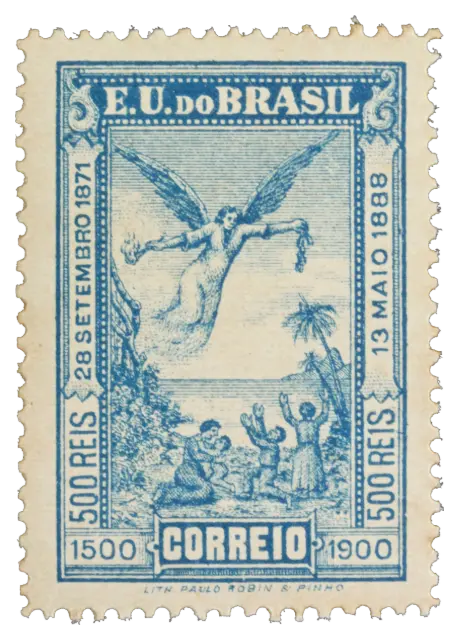
Illustration of a historical stamp for learning, shown at screen size. Not valid for postage.
How to read it
E. U. DO BRASIL at the top and CORREIO at the bottom: Brazil.
- 1E. U. DO BRASIL
- 228 SETEMBRO 1871
- 313 MAIO 1888
- Inscription
- E. U. DO BRASIL · 28 SETEMBRO 1871 · 13 MAIO 1888 · 500 REIS · CORREIO · 1500 1900
- Meaning
- “United States of Brazil”; the two dates are laws that ended slavery step by step.
- Issued by
- Brazil (United States of Brazil)
- Today
- Brazil Flag of Brazil
- Year
- 1900. Issued 1900 for 400 years since 1500.
- Made by
- Estevão Neiva (designer credited by Selo a Selo); Litografia Paulo Robin & Pinho (lithographic printing organisation)
One fact
The 500 réis names 28 September 1871, the law that freed children born to enslaved mothers, and 13 May 1888, when Brazil abolished slavery.
Source and public-domain rule
Brazil, government publication before the 1998 law. A Brazilian government publication of 1900: under the Civil Code of 1916 and Law 5988 of 1973 such works fell into the public domain 15 years after publication, long before the 1998 law. Under the Civil Code of 1916 (Art. 662) and Law 5988 of 1973 (Art. 46), works published by the Brazilian government fell into the public domain 15 years after publication. Government stamps published before 1983 had done so before the 1998 Copyright Law repealed those rules, which did not revive expired works. Legal sources: Lei 3.071 de 1916 (Civil Code), Art. 662, Lei 5.988 de 1973, Art. 46.
Scan: Selo Brasil 400 anos 1500 1900 500 reis.jpg on Wikimedia Commons (revision 1151512821), licence templates {{PD-BrazilGov}}. Downloaded 2026-10-22, sha256 144c496762d9…; cropped and cleaned for this site. Facts checked 2026-10-22 against source 1 and source 2. Research record, not legal advice; a second check of these rights by a person is planned, and a stamp that turns out not to be free to use will be removed. Spotted a mistake? Tell us.
