Belgium, 1849 (20 centimes, blue)
A king in uniform with large shoulder epaulettes, printed in blue.
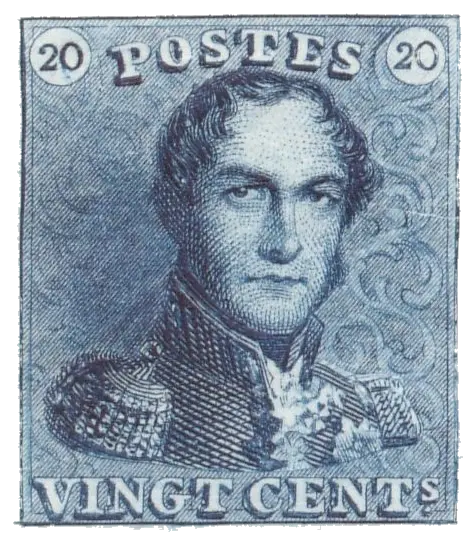
Illustration of a historical stamp for learning, shown at screen size. Not valid for postage.
How to read it
No country name: POSTES and VINGT CENTˢ are French, and the man in epaulettes is King Leopold I of Belgium.
- 1POSTES
- 2VINGT CENTˢ
- Inscription
- POSTES · 20 20 · VINGT CENTˢ
- Meaning
- French: “Posts” and “twenty centimes”. No country name.
- Issued by
- Belgium
- Today
- Belgium Flag of Belgium
- Year
- 1849. Issued 1 July 1849, Belgium’s first stamps.
- Made by
- Charles Baugniet (drawing, died 1886); Liévin De Winne (underlying portrait painting per Commons attribution, died 1880); Jacques (Jacob) Wiener (composition, died 1899); John Henry Robinson (engraving, died 1871)
One fact
The brown 10 and the blue 20 centimes were issued together in 1849; both show Leopold I, the first King of the Belgians.
Source and public-domain rule
Creators died more than 70 years ago. Drawing by Charles Baugniet (died 1886) after a painting by Liévin De Winne (died 1880), composition by Jacob Wiener (died 1899), engraving by John Henry Robinson (died 1871). Copyright lasts for the life of the author plus 70 years, counted from 1 January of the year after death. Every named designer and engraver of the stamp died before 1 January 1956; any contributor who was never named counts as anonymous, whose term is 70 years from publication, and the stamp was published before 1956. Legal sources: Directive 2006/116/EC, Art. 1(1) life + 70 years; Art. 1(3) anonymous works 70 years from publication; Art. 7(1) comparison of terms for works from outside the EU; Art. 8 terms run from 1 January, Switzerland, Norway.
Scan: Epaulette 20c.jpg on Wikimedia Commons (revision 1231416924), licence templates {{PD-old-100}}. Downloaded 2026-10-21, sha256 b4afb8ebb7ff…; cropped and cleaned for this site. Facts checked 2026-10-22 against source 1 and source 2. Open review note: Scan is 457×529 px; shown without upscaling.. Research record, not legal advice; a second check of these rights by a person is planned, and a stamp that turns out not to be free to use will be removed. Spotted a mistake? Tell us.
